
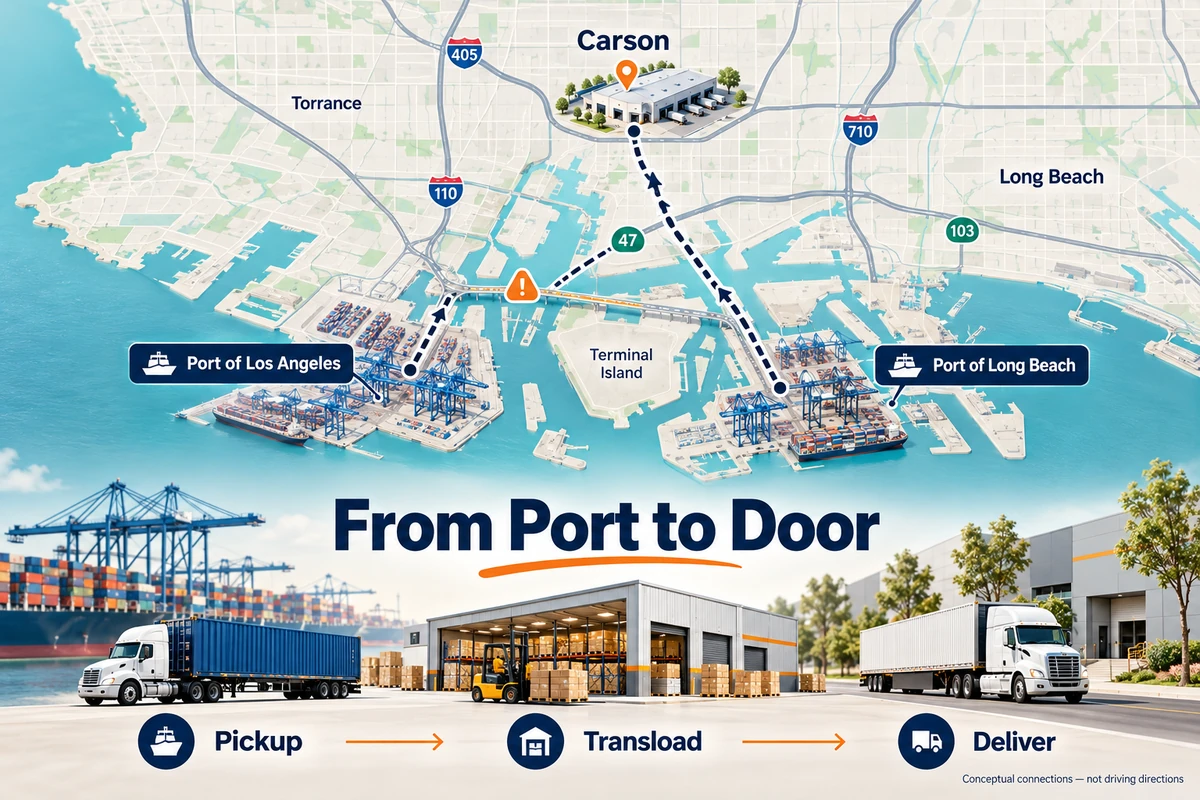
Container pickups at the Ports of Los Angeles and Long Beach may get slower over the coming months. That does not have to mean your cargo reaches its final destination later. How much time you lose often depends less on the port itself than on the handoffs between port pickup, warehouse, and delivery.
What Is Slowing Things Down
Record cargo volumes
According to official port statistics, September 2026 was historic for both ports:
- Port of Los Angeles: 1,042,652 TEUs, a new monthly record in its 118-year history.
- Port of Long Beach: 997,177 TEUs, up 25% year over year.
Combined, the two ports handled more than 2 million TEUs in a single month. Strong volume is good news for trade, but it puts extra pressure on trucking, chassis, terminal appointments, and warehouses.
Rail delays
Industry reports in October 2026 described tens of thousands of import containers waiting for on-dock rail at the two ports, some for nine days or longer. The Pacific Merchant Shipping Association reported average rail dwell time of 7.19 days in September, up from 6.75 days in August.
A container can come off the vessel on schedule and still lose days before it moves inland.
Vincent Thomas Bridge Closure: What It Means for Port Drayage
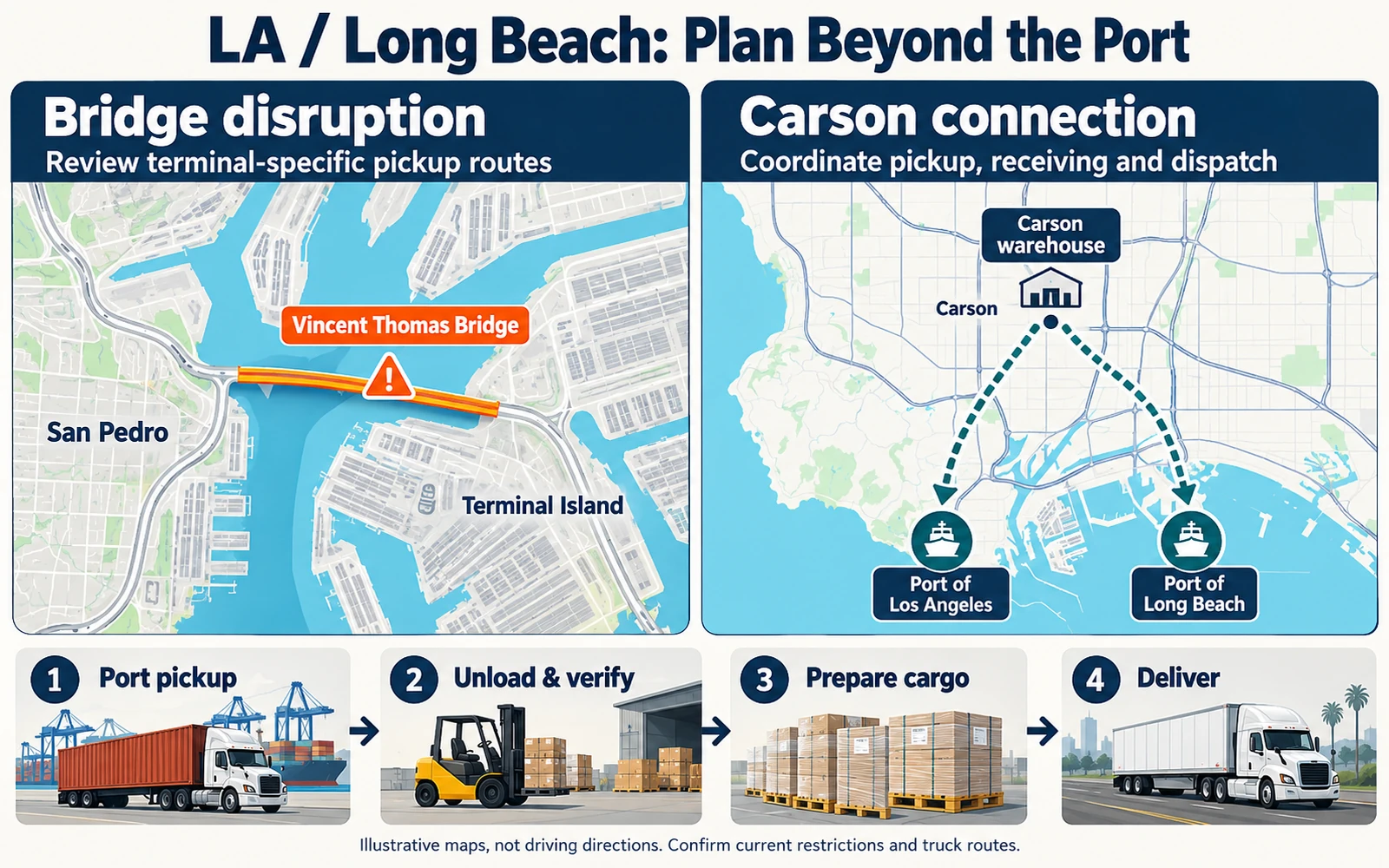
The Vincent Thomas Bridge is one of the main links for truck movements inside the San Pedro Bay port complex. Its planned full closure is the biggest local change importers should prepare for over the next 16 months.
What is closing, and when
According to Caltrans, the bridge will close completely at midnight on November 7, 2026, so that its 63-year-old deck can be replaced. It connects San Pedro and Terminal Island.
| Item | Detail |
|---|---|
| Closure starts | November 7, 2026 (full closure) |
| Duration | 16 months, for a bridge deck replacement |
| Scheduled reopening | Early March 2028 |
| Normal daily traffic | About 53,000 vehicles |
| Heavy trucks | Nearly 9% of daily traffic, according to Caltrans |
Not every truck on the bridge is moving port cargo. The Port of Los Angeles has said that roughly 8% of bridge traffic is trucks carrying port freight. Even so, that adds up to thousands of port-related truck trips a day that will need to be rerouted.
Detour routes and why they matter
Caltrans has designated detour routes that send traffic onto Front Street, John S. Gibson Boulevard, Harry Bridges Boulevard, and Henry Ford Avenue, with connections to Interstate 110 and Interstate 710.
These streets do not have the capacity of a four-lane bridge. Trucks will share them with local traffic and other port-related movements.
How a longer route turns into cost
- Longer trips
Detours add travel time to each one-way trip.
- Fewer trips per day
A truck can complete fewer pickup, delivery, and return cycles in a working day.
- Tighter trucking capacity
The effective number of available trucks shrinks even though the fleet size is unchanged.
- Crowded appointment windows
Terminal appointments become harder to book and harder to hit.
- Higher charge exposure
Longer waits for pickup can increase the risk of demurrage, detention, and chassis usage charges.
Chassis turnover is the hidden risk
When a longer cycle keeps a truck on the road, the chassis stays tied up for longer as well. Chassis availability is already tight in Long Beach, so the closure can reduce the usable chassis pool further. Every drop in chassis turnover adds cost somewhere in the supply chain.
What the ports are doing
The Port of Long Beach has announced that its incentive program will provide extra evening and Saturday gate hours at container terminals during the closure, giving customers more flexibility. Confirm current gate hours with your terminal before planning pickups.
Impact will vary
Not every shipment crosses the bridge. The effect depends on the terminal, pickup route, delivery destination, appointment availability, and time of day. Transloading does not suit every shipment, and it cannot guarantee faster transit times.
Where Port-to-Door Time Is Really Lost
After a container leaves the terminal, it may still wait for a chassis, a warehouse receiving slot, or the next trucking vendor to pick up the cargo.
When drayage, warehouse, and final delivery are handled by separate parties, every handoff adds waiting and coordination work. Putting pickup, unloading, and delivery under one coordinated operator reduces those gaps. No one can promise a faster transit time on every shipment, but a single accountable process can make the timeline more predictable and easier to track.
How Pickup-Transload-Delivery Works
- Port pickup
The container is moved from the marine terminal to a nearby warehouse through port drayage.
- Unload and verify
Cargo is unloaded, counted, and inspected as required. The empty container is returned according to carrier and terminal requirements.
- Palletize or consolidate
Cargo is prepared for the delivery method, whether palletized, relabeled, or consolidated.
- Delivery
Cargo is dispatched by fleet, LTL, or FTL, depending on volume and destination.
Many transload shipments go to one or a few addresses, so pickup, transload, and whole-load delivery by one operator is a common setup. Direct container delivery can still be the better choice in some cases. The table below shows how the two options usually compare.
| Factor | Direct container delivery | Transload plus delivery |
|---|---|---|
| Best suited for | One destination that can receive the full container | Cargo that needs unloading, palletizing, or flexible outbound transport |
| Container and chassis use | Occupied until delivery and return | Empty container can be returned after unloading, subject to terminal availability |
| Extra handling | None at a warehouse | Warehouse unloading and handling charges apply |
| Delivery flexibility | Limited to the receiver's dock and schedule | Cargo can be held, consolidated, or split into LTL or FTL shipments |
Compare the added warehouse handling cost with potential savings in trucking, equipment use, and delivery flexibility. Savings and timing are not guaranteed.
Why Our Carson Warehouse Location Matters
During the bridge closure, every truck hour near the port is worth more. A warehouse close to the marine terminals shortens the part of the journey that depends on scarce truck and chassis capacity.
| Item | Detail |
|---|---|
| Location | Carson, California, next to the APM Terminals area |
| Distance to terminal | About 13 miles, typically under 30 minutes in normal traffic |
| Facility type | CFS-supervised warehouse with bonded warehouse qualification |
| Cargo we handle | Transload shipments, including solar PV panels and other new energy equipment |
| US-to-Mexico | Full-container cargo can be unloaded, counted, and prepared for cross-border handoff |
How a near-port warehouse helps during the closure
- Shorter truck commitment: The container only needs a truck for the port-to-warehouse leg, rather than the full trip to the final destination.
- Smarter timing: Route choice and time windows matter more during the closure. Morning and evening slots that avoid peak traffic can decide how many containers are picked up in a day.
- Faster equipment turnover: Once cargo is unloaded, the empty container can be returned according to terminal and carrier requirements. That helps cut detention exposure, though terminal availability still applies.
- Flexible local delivery: After unloading, cargo can be consolidated or scheduled for off-peak delivery instead of occupying a full container and chassis.
US-to-Mexico cargo
Because the warehouse holds bonded warehouse qualification, it can handle full-container US-to-Mexico shipments.Cargo is palletized and prepared for cross-border documents in the warehouse. We coordinate the move from Los Angeles/Long Beach to Nogales, Arizona, and arrange the cross-border handoff and Mexico customs coordination with partners. Delivery to a designated warehouse in Mexico City is available as an option.
Key takeaway
The value of transloading during the closure is simple: use warehouse handling to reduce how long scarce trucks and chassis are tied up, so full-container resources go where they are really needed.
For more on our unloading and delivery services, see our transloading services.
Example: Handling High-Value Energy Equipment
This year we have handled a growing number of transload shipments for new energy and AI data center (AIDC) construction projects. Typical cargo includes solar PV panels for delivery within the United States, transformers, PCS units, and energy storage cabinets. Word of this work has been spreading among US transload operators.
This cargo is usually palletized at origin, which makes unloading efficient. The cargo is also high in value, and customers sometimes have requirements for unloading equipment operation and for recording key handling steps. We provide value-added services as needed, such as:
- Photos of the container exterior showing the container number
- Photos of unopened cartons
- Photos taken when the container is opened
Delivery is handled by our own fleet and drivers, which closes the loop from port pickup to final delivery under one operator. In-transit vehicles use GPS tracking, so delivery progress can be checked at any time.
Practical Steps Before the Bridge Closes
- Review your pickup plan. Confirm which terminal your containers use and how the closure may affect your route.
- Plan empty returns. Coordinate returns and watch free-time deadlines.
- Compare delivery options. Evaluate direct container delivery against transload plus delivery on total cost, not just trucking rate.
- Choose the right warehouse. Look for port proximity, unloading capacity, yard space, and outbound options.
- Build in buffer. Allow for changes in terminal appointments, trucking availability, and warehouse receiving.
Frequently Asked Questions
Will the Vincent Thomas Bridge closure affect every shipment?
No. The impact depends on the terminal, pickup route, warehouse location, and delivery destination.
Can transloading help reduce detention charges?
It can reduce exposure by allowing an earlier empty-container return, but savings are not guaranteed. Terminal availability, free time, carrier instructions, and warehouse schedules all apply.
Is transloading always better than direct container delivery?
No. Direct delivery can cost less when all cargo goes to one location that can receive the full container. Transloading fits better when cargo needs handling, palletizing, or flexible outbound transportation.
Can cargo be delivered to multiple destinations after transloading?
Yes. After unloading and sorting, cargo can be split into separate LTL or FTL shipments.
Can you document the unloading process for high-value cargo?
Yes, as a value-added service on request. Typical records include photos of the container number, unopened cartons, and the container being opened. Please tell us your requirements in advance, including any requirements for unloading equipment operation.
Need help planning your port pickup, transload, and delivery?
Share your route, cargo details, and receiving requirements so our team can review the next step.