
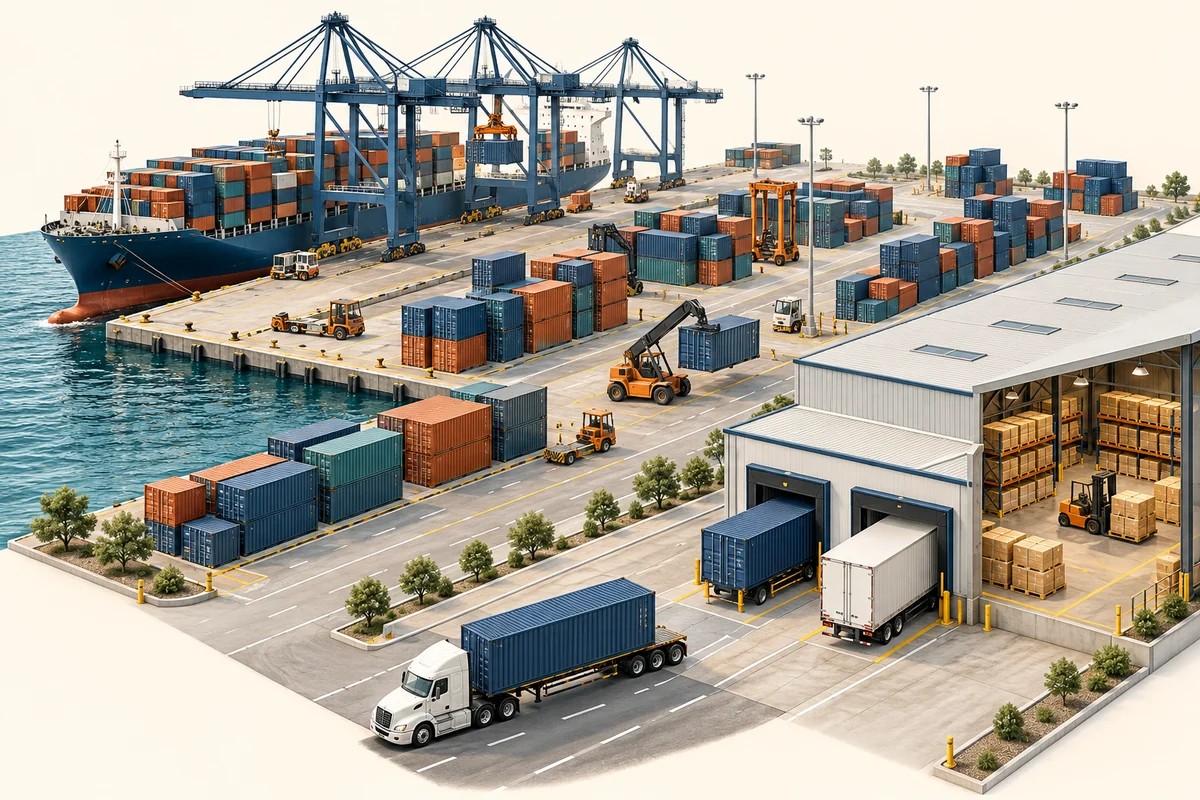
This guide is for importers, buyers, exporters and anyone who handles freight quotes and shipment updates. It explains eight common port, container and tracking terms, including POL, POD, CFS, CY, ETA and B/L, so you can read your quote, follow your shipment's status and know what to confirm before you book.
This guide covers port, container and tracking terms. For service types such as FCL, LCL, LTL and door-to-door, see our guide to freight service terms.
Quick reference
The examples below are illustrative scenarios to help you picture each term. They are not customer cases.
| Term | What it means | Where you'll see it | Example |
|---|---|---|---|
| POL Port of Loading |
The port where cargo is loaded onto the vessel. | Quotes, booking confirmations, bills of lading. | A quote lists an Asian port as the POL, so the ocean leg starts from that port. |
| POD Port of Discharge |
The port where cargo is unloaded from the vessel. In some business contexts it can also mean the place of delivery. | Quotes, arrival notices, tracking updates. | A quote lists a U.S. West Coast port as the POD, so the container is unloaded there before inland movement. |
| CFS Container Freight Station |
A facility where cargo is loaded into or unloaded from containers, commonly used for LCL. | LCL quotes, arrival notices, handling charges. | An LCL container arrives at a CFS, where each shipper's cartons are separated and released. |
| CY Container Yard |
A terminal area where loaded containers are stored and handled. | FCL quotes, pickup instructions, terminal notices. | A full container is picked up from the CY by a trucker and taken to the consignee's warehouse. |
| Drayage | Short-distance container trucking between ports, rail yards and warehouses. | FCL quotes, port pickup line items. | A truck collects a container at the port and delivers it to a nearby warehouse. |
| Transloading | Transferring cargo from one container or transport mode to another. | Quotes for cargo moving beyond the port area. | Goods from a 40' ocean container are moved into trailers for onward delivery. |
| ETD / ETA Estimated Time of Departure / Arrival |
The expected departure or arrival time. Both are estimates, not guarantees. | Booking confirmations, schedules, tracking updates. | A vessel's ETA moves back by two days, and the delivery plan is adjusted accordingly. |
| B/L Bill of Lading |
The carrier's document that serves as a receipt for the cargo, evidence of the contract of carriage and, in some forms, a document of title. | Shipping documents, cargo release, customs filings. | The consignee presents the B/L, or receives a release instruction, to collect the cargo. |
POL (Port of Loading)
What it means. The port where cargo is loaded onto the ocean vessel. It is where the ocean leg begins.
Why it matters. The POL affects the transit route, the schedule and the origin charges on your quote. It is not always the nearest port to your supplier, so confirm it before booking.
Common misconception. The POL is not the same as the pickup address. A factory pickup address is where cargo starts its journey. The POL is where it boards the vessel, and trucking between the two may be quoted separately.
What to confirm in a quote:
- The exact POL, including the city and country.
- Whether origin trucking to the POL is included.
- Which origin charges apply.
POD (Port of Discharge)
What it means. The port where cargo is unloaded from the vessel. For U.S. imports, this is the arrival port, such as Los Angeles, Long Beach, New Jersey or Savannah.
POD can mean two things
In ocean freight, POD usually means Port of Discharge. In some trucking and delivery contexts, it is used to mean the place of delivery. If a quote only says "POD," ask which one it refers to, because the cost and route are different.
Why it matters. The POD determines where your container is unloaded, which terminal it comes out of, and how far it must travel inland. See our pages for Los Angeles, Long Beach, New Jersey and Savannah.
What to confirm in a quote:
- The exact POD and the final delivery address.
- Whether the quote ends at the port or includes inland delivery.
- Whether terminal and port-related fees are included.
CFS (Container Freight Station)
What it means. A facility where cargo is loaded into containers at origin, or unloaded and separated at destination. CFS is commonly used for LCL shipments, where cargo from several shippers shares one container.
When you'll see it. On LCL quotes, as in "CFS handling" or "CFS charges," and on arrival notices telling you where to collect your cargo. See our LCL shipping and delivery service.
Common misconception. CFS is not a warehouse for long-term storage. It is a handling point, and storage time there is usually limited and may be charged.
What to confirm in a quote:
- Which CFS will handle the cargo.
- What the CFS charges cover, such as unloading, sorting and release.
- Any storage time limit and the charges after it.
CY (Container Yard)
What it means. The terminal area where containers are stored and handled before loading onto a vessel or after unloading. CY is commonly used for FCL shipments, where the whole container is handled as one unit.
When you'll see it. On FCL quotes and pickup instructions. Terms such as "CY to CY" or "CY to door" describe where the carrier's responsibility starts and ends. See our FCL ocean freight service.
Common misconception. A full container sitting in the yard is not unlimited free storage. Terminals and carriers set free time, and charges can apply once it runs out. For context, see why containers get stuck at U.S. ports.
What to confirm in a quote:
- Whether the service is CY to CY, CY to door or another combination.
- The free time available at the terminal.
- Terms for extra days, such as detention and demurrage.
Drayage and transloading: the moves after the port
These two terms describe what happens to a container or its cargo after it leaves the vessel. They are often confused, and a shipment may need both.
Drayage
Short-distance trucking of a container between locations such as a port, a rail yard and a warehouse. It is usually the first move after discharge, and it is typically quoted as "drayage" or "port pickup." It is different from long-haul trucking, which is usually quoted as FTL or LTL. See our port pickup and drayage service.
Transloading
Transferring cargo from one container, trailer or transport mode to another, for example unloading an ocean container and reloading the goods into trucks for onward delivery. It is different from warehousing, which focuses on storing cargo. See our transloading service.
What to confirm in a quote:
- Which of these steps are included, and which are quoted separately.
- The pickup terminal and the delivery address.
- Any related line items, such as surcharges or handling fees.
ETD and ETA
What they mean. ETD is the estimated time of departure. ETA is the estimated time of arrival. Both can apply to a vessel, a flight or a truck.
ETD and ETA are estimates
Vessel schedules can change because of weather, port congestion, carrier decisions and other factors. Treat an ETA as a planning estimate, not a delivery guarantee, and ask your provider to notify you of changes.
Why it matters. The ETA of the vessel is not the same as the date you can pick up or receive your cargo. After arrival, cargo still needs to be unloaded, cleared and released before delivery.
What to confirm in a quote:
- Which date is quoted: vessel ETD, vessel ETA or expected delivery.
- How schedule changes will be communicated.
- What steps happen between arrival and delivery.
B/L (Bill of Lading)
What it means. A document issued by the carrier or its agent that serves three purposes. It is a receipt confirming the cargo was received, evidence of the contract of carriage, and, in some forms, a document of title that controls who can collect the cargo.
When you'll see it. In shipping documents, customs filings and cargo release. Common types include the master B/L issued by the ocean carrier and the house B/L issued by a freight forwarder.
Common misconception. A B/L is not a commercial invoice. The invoice records the sale between buyer and seller, while the B/L records the carriage of the cargo. Also, how the B/L is released, as an original, by telex release or as a sea waybill, can affect when cargo can be collected, so agree on it before shipping.
What to confirm in a quote:
- The consignee and notify party named on the B/L.
- How the B/L will be released.
- Whether any documentation fees apply.
How the terms fit together in one shipment
Here is a simplified example of an ocean import, to show where each term appears. Actual steps vary by shipment.
- Booking and B/L
The shipment is booked, and the carrier issues the B/L showing the POL, the POD and the consignee.
- Departure (ETD)
Cargo is loaded at the POL. For LCL, cargo is consolidated at a CFS first. For FCL, the container is loaded and delivered to the CY.
- Ocean transit and ETA
The vessel sails to the POD. The ETA may be updated as the voyage progresses.
- Discharge at the POD
The container is unloaded from the vessel. For LCL, it is moved to a CFS for devanning. For FCL, it is held in the CY awaiting pickup.
- Drayage
Once cargo is released, a trucker collects the container and moves it to the next location.
- Transloading and delivery
If needed, cargo is transloaded into other equipment and delivered to the final address.
How to read your freight quote
- Check the route first: confirm the POL and POD, and make sure "POD" means what you think it means.
- Check where the quote starts and ends: CY to CY, CFS to door or door to door change what is included.
- Check the port-side steps: look for drayage, CFS handling and transloading as separate lines.
- Check the dates: know whether you are looking at an ETD, an ETA or a delivery date.
- Check the documents: agree on the B/L type and release method before cargo ships.
For service types and delivery formats, see our guide to freight service terms, or browse all ANL services.
Frequently Asked Questions
What is the difference between POL and POD?
POL is the port where cargo is loaded onto the vessel at origin. POD is the port where cargo is unloaded at the destination.
What is the difference between CFS and CY?
A CFS is a facility where cargo is loaded into or unloaded from containers, commonly used for LCL. A CY is a terminal area where whole containers are stored and handled, commonly used for FCL.
Does POD always mean Port of Discharge?
Not always. In ocean freight it usually means Port of Discharge, but in some trucking and delivery contexts it refers to the place of delivery. Ask which one a quote means.
Is an ETA a guaranteed arrival date?
No. An ETA is an estimate and can change. It is also the vessel's arrival, not the date your cargo is ready for delivery.
What does a bill of lading do?
It acts as the carrier's receipt for the cargo, evidence of the contract of carriage and, in some forms, a document of title that controls who may collect the cargo.
Need help reading a quote or planning a shipment?
Share your route, cargo details and receiving requirements so our team can review the options.