
When reviewing freight quotes, you’ll often run into a long list of service-type abbreviations. Most of the time, you just want the service that fits your shipment, not a wall of industry jargon. Choosing the wrong service type can also lead to a quote that doesn’t match the shipper’s actual needs. To help with this, this guide breaks down eight common service types and cargo formats, explaining what each one means and when to use it.
This guide covers service types and cargo formats only.
Quick reference
The examples below are illustrative scenarios to help you picture each service. They are not customer cases.
| Term | What it means | Who it suits | Example |
|---|---|---|---|
| DTD Door-to-Door |
One provider coordinates the shipment from the pickup address to the delivery address. | Importers who want a single point of contact instead of managing several vendors. | A buyer wants cargo collected at a factory abroad and delivered to its U.S. warehouse, with one provider coordinating every leg. |
| FCL Full Container Load |
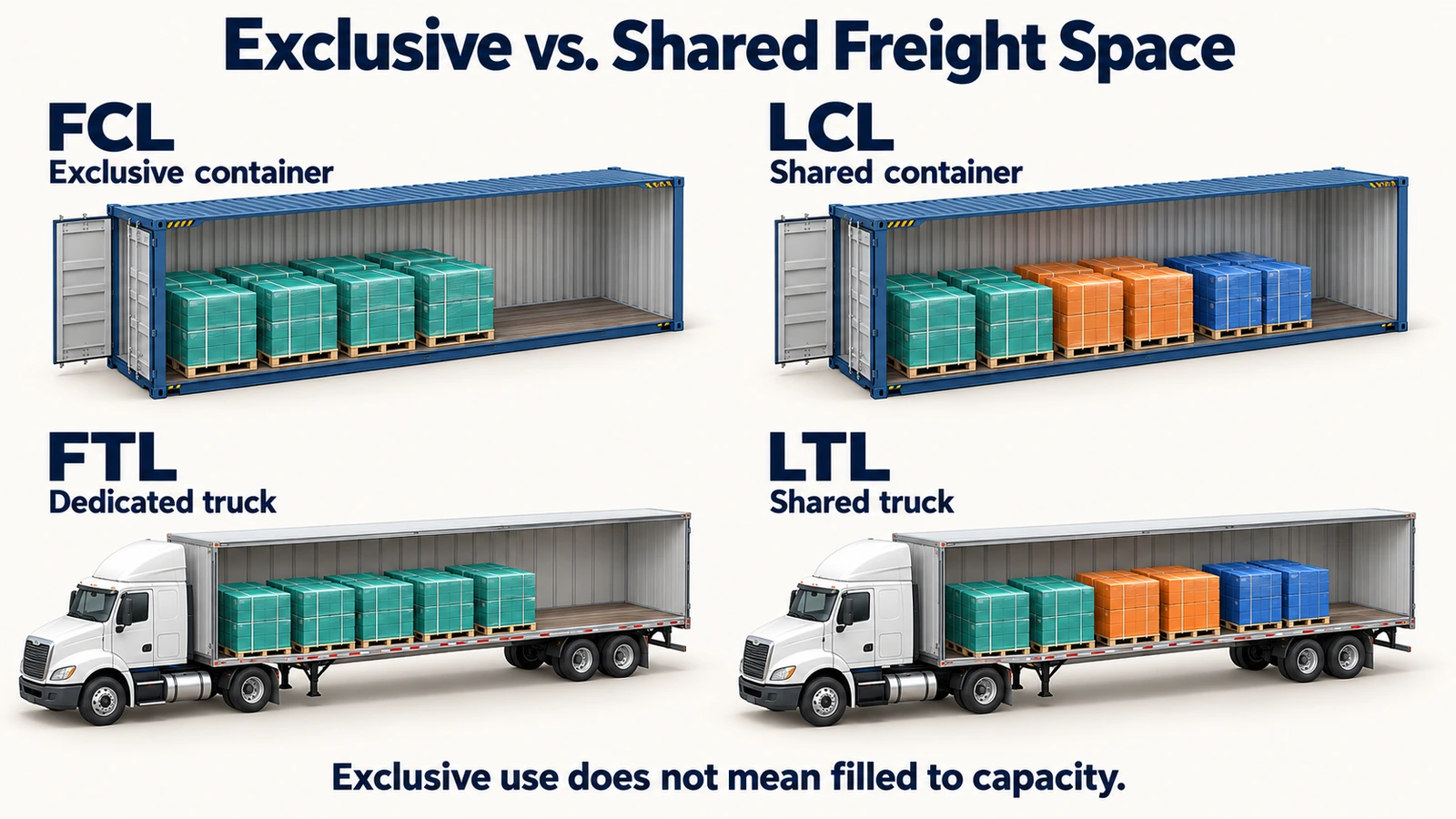
You use an entire container. | Shippers with larger volumes, or who want their cargo kept separate from others'. | A home goods brand fills a 40' container with furniture and décor for delivery to one U.S. warehouse. |
| LCL Less than Container Load |
Your cargo shares a container with other shippers' cargo. | Smaller importers whose volume doesn't justify a full container. | An importer placing a trial order of a few pallets ships it as part of a consolidated container. |
| Air Freight | Cargo moves by air carrier. | Shippers with urgent, high-value or lighter cargo. | A brand needs a restock of a fast-selling item to arrive faster than ocean transport allows. |
| FTL Full Truckload |
One truck and trailer dedicated to your freight. | Distributors and manufacturers moving large domestic loads. | A distributor moves a full trailer of pallets from a port-area warehouse to a regional distribution center. |
| LTL Less than Truckload |
Your freight shares truck space with other shipments. | Businesses moving a few pallets that don't need a whole truck. | A retailer sends three pallets from a warehouse to a store location. |
| Last-Mile Final Mile Delivery |
The final leg from a warehouse or facility to the consignee. | Shippers delivering large or palletized goods to businesses or residences. | A furniture maker's bulky items are delivered to a customer's home on a scheduled appointment. |
| Fulfillment Order Fulfillment |
Storing inventory, then picking, packing and shipping orders. | Sellers with recurring orders rather than one-off shipments. | An online seller keeps inventory in a U.S. warehouse and ships customer orders from there. |
DTD (Door-to-Door)
What it means. A service structure in which one provider arranges or coordinates the shipment from the shipper's pickup address to the consignee's delivery address, including the main transport leg and the handling at either end.
When it fits. When you don't want to manage separate vendors for origin pickup, main transport, destination handling and final delivery. It is common for importers and distributors who want a single point of contact. To see how a door-to-door move looks in practice, read our Malaysia to Philadelphia cabinet DTD case study.
DTD is not the same as DDP
DTD describes the service scope: who arranges the movement. DDP (Delivered Duty Paid) is an Incoterms® rule that describes who bears duties, taxes and risk between buyer and seller. A DTD shipment can be quoted with or without duties and taxes, so confirm in writing what your quote covers.
What to confirm in a quote:
- Pickup and delivery addresses.
- Whether import clearance, duties and taxes are included.
- What is excluded, such as appointment fees, inside delivery or storage.
FCL (Full Container Load)
What it means. Shipping in a container reserved for one shipper's cargo. Common sizes are 20', 40' and 40' High Cube. See our FCL ocean freight service.
When it fits. When your volume is large enough to fill or nearly fill a container, or when you want your cargo kept separate from other shippers' goods. Cargo is typically loaded once at origin and not handled again until the container is opened at the destination.
Common misconception. "Full container" refers to exclusive use of the container, not necessarily that it is packed to capacity. Weight limits also matter: a container can reach its legal road weight limit before it is full of volume, which affects inland trucking.
What to confirm in a quote:
- Container size and type.
- Port of discharge and final delivery address.
- Port pickup and drayage and chassis charges.
- Detention and demurrage terms. For context on why containers get delayed, see why containers get stuck at U.S. ports.
LCL (Less than Container Load)
What it means. Shipping cargo that doesn't fill a container. A consolidator combines shipments from multiple shippers into one container at origin. At the destination, the container is opened at a freight station or warehouse, and each shipper's cargo is separated and released.
When it fits. When your volume doesn't justify a full container and you can accept additional handling steps. See our LCL shipping and delivery service.
Common misconception. LCL usually involves more handling and coordination than FCL. Cargo is consolidated at origin, then deconsolidated, sorted and released at destination, so there are more steps and more parties, and carton labeling and documentation matter more.
Air Freight
What it means. Moving cargo by air carrier, either airport to airport or as part of a door-to-door service. See our air freight to the USA service.
When it fits. Time-sensitive, high-value or lighter cargo, or when inventory needs to reach the destination faster than ocean transport allows.
Common misconception. Air freight is priced on chargeable weight, the greater of actual weight and volumetric (dimensional) weight, so a light but bulky shipment can cost more than expected. Also, "air freight" alone often means airport-to-airport. If you need delivery to an address, ask for air freight door-to-door.
What to confirm in a quote:
- Whether the price is airport-to-airport or door-to-door.
- How chargeable weight is calculated.
- Restrictions on batteries, liquids and other regulated items.
FTL (Full Truckload)
What it means. A truck and trailer dedicated to a single shipper's freight for one move.
When it fits. Large shipments, such as many pallets or full container contents moved to a warehouse, or freight that benefits from fewer touchpoints and direct transit. Moving cargo out of a container at the port first? See transloading.
Common misconception. FTL is not only about weight. A truckload can be justified by pallet count, cargo volume, handling sensitivity or schedule. It is priced per truck movement, typically by lane and distance, rather than per pound.
What to confirm in a quote:
- Equipment type.
- Pickup and delivery windows.
- Free time for loading and unloading.
- Accessorial charges.
LTL (Less than Truckload)
What it means. Moving smaller freight that shares truck space with other shippers' shipments. Freight is often handled through terminals along the way. See our LTL freight shipping service.
When it fits. A few pallets or a smaller shipment that doesn't need a whole truck.
Common misconception. LTL pricing depends on more than weight. Dimensions, freight class, pallet count and required services all influence the cost. Because freight may be handled at terminals, accurate dimensions and packaging matter.
What to confirm in a quote:
- Weight and packed dimensions.
- Freight class, if applicable.
- Additional services needed at delivery.
- Delivery appointment requirements.
Final Mile / Last-Mile Delivery
What it means. The last leg of the journey, moving freight from a warehouse, transload facility or distribution center to its final recipient: a customer, a retail location, a job site or a residence. See our final delivery service.
When it fits. Any shipment where final delivery has special requirements, such as delivery appointments, residential addresses, large or heavy items, or specific delivery windows. For oversized or bulky items going to Amazon, see our FBA bulky cargo delivery solution.
Common misconception. Last-mile delivery for bulky or palletized freight is different from small-parcel delivery. Large and oversized items may involve appointment scheduling, residential access constraints and extra handling. Delivery to a residential address typically carries different requirements and charges than delivery to a commercial dock.
What to confirm in a quote:
- Whether the address is residential or commercial.
- Unloading access and any equipment needed.
- Appointment requirements.
- Failed-delivery policy.
Order Fulfillment
What it means. The set of warehouse processes that turn an order into a delivered shipment: receiving and storing inventory, picking items, packing, labeling and shipping. See our order fulfillment service.
When it fits. When you have recurring orders to ship from U.S. inventory rather than one-time freight movements, for example orders to retailers, distributors or end customers. Online sellers can also see our solution for e-commerce sellers.
Common misconception. Fulfillment is not the same as warehousing. Warehousing is storing inventory. Fulfillment adds the order-level work of picking, packing and shipping. Capabilities also vary between providers, such as order volume, system integration and the types of products handled, so confirm what is actually included before assuming.
What to confirm in a quote:
- Receiving and storage charges.
- Pick-and-pack fees and packaging materials.
- How orders are submitted and tracked.
- Available carrier options.
How to choose the right service
- Large volume, one destination: consider FCL, with drayage and delivery as needed.
- Smaller volume, flexible timing: consider LCL.
- Urgent or high-value cargo: consider air freight door-to-door.
- Moving freight within the U.S.: FTL for a full load, LTL for smaller loads.
- Want one provider to manage the chain: ask for DTD and confirm what is included.
- Recurring orders from U.S. inventory: look at warehousing and order fulfillment.
You can also browse all ANL services, or see how we work with importers.
Frequently Asked Questions
What is the difference between DTD and DDP?
DTD describes the transportation service scope, from pickup to final delivery. DDP is an Incoterms® rule that allocates duties, taxes and risk between buyer and seller. They are different concepts and are not interchangeable.
What is the difference between FCL and LCL?
FCL means you use an entire container. LCL means your cargo shares a container with other shippers' cargo and is separated at the destination.
What is the difference between FTL and LTL?
FTL dedicates a truck to one shipper's freight. LTL shares truck space among multiple shippers' shipments.
Is last-mile delivery the same as parcel delivery?
No. Last-mile can refer to palletized, large or heavy freight, which has different handling and access requirements than small parcels.
Is order fulfillment the same as warehousing?
No. Warehousing is storing goods. Fulfillment adds order-level picking, packing and shipping.
Not sure which service fits your shipment?
Share your route, cargo details and receiving requirements so our team can review the options.